Procrastination. What's not to like about it? (Except for the feeling that you got nothing done despite the fact that you pulled an all-nighter.)
How did I ever procrastinate before the ubiquitous internet?? Come to think of it, how did I procrastinate before blogs and social networks? Let's see... In college I used to procrastinate by checking email using Pine in the computer lab (only 1 of the 6 roommates had a computer with an ethernet connection in our room), or by watching The X Files and The Simpsons recorded on a worn VHS tape. Dare I think back to my pre-email days? I really don't have a clue how I procrastinated then. I suppose it was just watching whatever was on TV and talking to friends on the phone (a landline phone with a cord plugged into the wall of course). Ah, the good old days.
My new procrastination tool is the subject of this post. Food blogs! The one in particular that I'm in love with now is Smitten Kitchen. Her writing is funny and interesting, the pictures are beautiful, and the recipes look fabulous. My mouth was watering and my stomach growling for these in particular. Another recipe on the 'must try ASAP' list. Her latest is that she made a wedding cake for some friends' wedding this weekend. I am waiting with bated breath for the final installment! I found the site somewhat randomly last week. Daily Candy sent me to this food blog for a white sangria recipe (also on the 'must try ASAP' list), and Smitten was on his blog roll.
Enjoy blog hopping around my links on the right. And don't blame me if you spend 3 hours reading them when you're supposed to be working...
Monday, July 7, 2008

Thursday, July 3, 2008
Baby food
No, this is not about actual food for babies, although I've started to have fun with that now that the O-man is on solids. However, this post is about food that works for adults when there's a baby in the house. That's not to say you can't make it if there isn't a baby in your house (which is probably the case for 95% of my readers). It's just that about 2 months after the O-man was born, I realized that baby-friendly dinner is not the same as working-until-8pm friendly.
Let me explain. Now I actually want things that take an hour or more to bake in the oven or simmer on the stovetop so that we can concentrate on feeding and bathing the baby and getting him to sleep just before we eat rather than cooking something that's fast, but takes a lot of prep time at the end and/or is best eaten as soon as it's ready (eg, sitr fries). I've also learned that prepping as much as possible ahead of time when the baby is napping is key, but more on that in another post I think.
Today we're going to concentrate on things that cook slowly in the oven. Lasagna is one of my favorites of these, but again, I have planned that for another post about making over your leftovers. I'm thinking about this yummy cross between mac and cheese and tuna casserole that I made a few weeks ago.
First, a slight digression about tuna casseroles. My parents are from the Midwest. I grew up eating my Grandma's 'Friday Tuna Casserole' (she wasn't Catholic so I suspect the recipe wasn't actually hers), which included a can of Campbell's cream of mushroom soup and a large quantity of crushed potato chips both inside the casserole and sprinkled on top for crunch. When I lived in the US, I am almost ashamed to say that a regular staple in our dinner rotation was a box of Kraft macaroni and cheese (you know, the one with the powdered, radioactive orange cheese) with tuna-in-a-can and a handful of frozen peas thrown in. This is inspired by that, but is slightly less processed and definitely more homemade!
The recipe is a blend of two from the Food Network, one from Ina Garten (again) and one from Dave Lieberman. Those recipes are here and here. I couldn't quite fathom the amount of butter and cheese in Ina's recipe, but I liked the idea of the tomatoes on top.
Cheesy pasta with tuna, peas and tomatoes
1/2 lb pasta (I suppose macaroni is ideal, but I only had farfalle so used that)
1 1/4 c milk (I used skim because I had it and it tasted fine, but I'm sure it would be creamier with whole milk)
2 1/2 T unsalted butter, divided
1 1/2 T flour
1 3/4 c shredded cheese (I used 1 c mature cheddar, 1/2 c mozzarella and 1/4 c Parmesan)
1/4 tsp freshly ground pepper
1/8 tsp red pepper flakes
Yellow mustard (or mustard powder)
1 can tuna fish, drained
1 c frozen peas
Tomatoes (I used halved cherry tomatoes but slices of big tomatoes would be fine)
1 c fresh breadcrumbs (I used wheat sandwich bread because it was all I had, but I think day-old baguette or something similar would probably be best). If you've never made homemade breadcrumbs before, it's really easy-just cut the bread into chunks and process in a food processor for about a minute. If you don't have a food processor, a blender might work.
Cook the pasta to al dente according to package directions (see TIP below). You want it to be a bit under-cooked since it will get softer in the oven.
Melt 1.5 T butter in a pot and whisk in flour. Cook for 2 minutes (stir frequently if not constantly). Add milk, whisking to prevent any lumps, and cook for 1-2 minutes until thick and smooth. Take off the heat and stir in the cheeses and pepper. Add in the red pepper flakes and a squirt of mustard.
Mix the cheese sauce with the pasta and add the tuna and peas. Put in a baking dish (I used a 10x7 inch oval gratin dish, so an 8 inch square would be similar). Top with the tomatoes (cut side up for cherry tomatoes) and sprinkle with salt and pepper. Mix the bread crumbs with 1 T melted butter and some pepper and then sprinkle these on top of the tomatoes.
Bake at 375 F (190 C) for 30-35 minutes.
NOTE: The leftovers weren't as great as I was hoping, so it's good if you can use it all up the same day. This makes 2 REALLY generous servings, but probably more like 3-4.
TIP: Always add salt to your pasta water (I don't think oil is necessary). Apparently if you have pots with stainless interiors, salt will mark and pit your pot, so you should add it just before adding the pasta. I was always under the impression that it makes sense to wait until the water's boiled to add salt since the salt will raise the boiling point of the water, and therefore make it take longer for your water to boil. However, the change is apparently insignificant, and interestingly the same volume of 20% salt water boils faster than pure water owing to heat capacity. Ah, chemistry...
Let me explain. Now I actually want things that take an hour or more to bake in the oven or simmer on the stovetop so that we can concentrate on feeding and bathing the baby and getting him to sleep just before we eat rather than cooking something that's fast, but takes a lot of prep time at the end and/or is best eaten as soon as it's ready (eg, sitr fries). I've also learned that prepping as much as possible ahead of time when the baby is napping is key, but more on that in another post I think.
Today we're going to concentrate on things that cook slowly in the oven. Lasagna is one of my favorites of these, but again, I have planned that for another post about making over your leftovers. I'm thinking about this yummy cross between mac and cheese and tuna casserole that I made a few weeks ago.
First, a slight digression about tuna casseroles. My parents are from the Midwest. I grew up eating my Grandma's 'Friday Tuna Casserole' (she wasn't Catholic so I suspect the recipe wasn't actually hers), which included a can of Campbell's cream of mushroom soup and a large quantity of crushed potato chips both inside the casserole and sprinkled on top for crunch. When I lived in the US, I am almost ashamed to say that a regular staple in our dinner rotation was a box of Kraft macaroni and cheese (you know, the one with the powdered, radioactive orange cheese) with tuna-in-a-can and a handful of frozen peas thrown in. This is inspired by that, but is slightly less processed and definitely more homemade!
The recipe is a blend of two from the Food Network, one from Ina Garten (again) and one from Dave Lieberman. Those recipes are here and here. I couldn't quite fathom the amount of butter and cheese in Ina's recipe, but I liked the idea of the tomatoes on top.
Cheesy pasta with tuna, peas and tomatoes
1/2 lb pasta (I suppose macaroni is ideal, but I only had farfalle so used that)
1 1/4 c milk (I used skim because I had it and it tasted fine, but I'm sure it would be creamier with whole milk)
2 1/2 T unsalted butter, divided
1 1/2 T flour
1 3/4 c shredded cheese (I used 1 c mature cheddar, 1/2 c mozzarella and 1/4 c Parmesan)
1/4 tsp freshly ground pepper
1/8 tsp red pepper flakes
Yellow mustard (or mustard powder)
1 can tuna fish, drained
1 c frozen peas
Tomatoes (I used halved cherry tomatoes but slices of big tomatoes would be fine)
1 c fresh breadcrumbs (I used wheat sandwich bread because it was all I had, but I think day-old baguette or something similar would probably be best). If you've never made homemade breadcrumbs before, it's really easy-just cut the bread into chunks and process in a food processor for about a minute. If you don't have a food processor, a blender might work.
Cook the pasta to al dente according to package directions (see TIP below). You want it to be a bit under-cooked since it will get softer in the oven.
Melt 1.5 T butter in a pot and whisk in flour. Cook for 2 minutes (stir frequently if not constantly). Add milk, whisking to prevent any lumps, and cook for 1-2 minutes until thick and smooth. Take off the heat and stir in the cheeses and pepper. Add in the red pepper flakes and a squirt of mustard.
Mix the cheese sauce with the pasta and add the tuna and peas. Put in a baking dish (I used a 10x7 inch oval gratin dish, so an 8 inch square would be similar). Top with the tomatoes (cut side up for cherry tomatoes) and sprinkle with salt and pepper. Mix the bread crumbs with 1 T melted butter and some pepper and then sprinkle these on top of the tomatoes.
Bake at 375 F (190 C) for 30-35 minutes.
NOTE: The leftovers weren't as great as I was hoping, so it's good if you can use it all up the same day. This makes 2 REALLY generous servings, but probably more like 3-4.
TIP: Always add salt to your pasta water (I don't think oil is necessary). Apparently if you have pots with stainless interiors, salt will mark and pit your pot, so you should add it just before adding the pasta. I was always under the impression that it makes sense to wait until the water's boiled to add salt since the salt will raise the boiling point of the water, and therefore make it take longer for your water to boil. However, the change is apparently insignificant, and interestingly the same volume of 20% salt water boils faster than pure water owing to heat capacity. Ah, chemistry...
Wednesday, July 2, 2008
Oops
I sort of forgot I had this blog. The nearly-mobile O-man has me busy when he's awake, and when he's asleep I'm always cooking and pureeing new foods for him to try.
I actually have a post I started 3 weeks ago that is 95% finished; hopefully I'll find time for the other 5% soon!
I actually have a post I started 3 weeks ago that is 95% finished; hopefully I'll find time for the other 5% soon!
Tuesday, June 10, 2008
CUPCAKES!
My hubby's birthday was last weekend, and I made him carrot cake cupcakes with cream cheese frosting that turned out quite well (if I do say so myself). The tip here is that, although these in no way can really be considered healthy or low fat, I have reduced the fat by replacing half of the oil in the cupcakes with natural (no sugar or sweetener added) applesauce. You can do this in other baked items that use a lot of oil (muffins and banana bread are two good examples).
The recipe itself is actually a cross between my friend M's carrot cake recipe and one for carrot cake cupcakes from Ina Garten. They were quite similar, and the only major change I made is really the addition of the applesauce. A note for readers in the UK: In America, applesauce is everywhere. Here, not so much. I bought a jar of Bramley applesauce, but it just wasn't right. So I went to the baby food aisle and found little pots of apple and pear puree that were mostly apples, with nothing else added to sweeten. It worked great!
I made 1.5 times the original recipe because it was only supposed to make 22 cupcakes. However, out of the 1.5x batch, I ended up with 40. The amounts for 40 are below and the original amounts (I guess that will give you about 26) in parentheses.
Without further ado, the recipe:
3 cups sugar (2 c)
1 cup vegetable oil (2/3 c)
1 cup natural/unsweetened applesauce (2/3 c)
1.5 teaspoons pure vanilla extract (1 t)
5 large eggs (3)
3 cups all-purpose flour (2 c)
3 teaspoons ground cinnamon (2 t)
3 teaspoons baking soda (2 t)
1 1/4 teaspoons salt (~3/4 t) [Note: this is less salt than the Ina recipe called for, as many reviews said the cupcakes were too salty.]
4 1/2 cups grated carrots; about 1.5 pounds (3 c or about 1 pound)
1 1/2 cups golden raisins (sultanas for those of you in the UK) (1 c)
1 1/2 cups chopped walnuts (1 c); pecans would be good as well
Preheat the oven to 350 degrees F (175 degrees C).
The recipe itself is actually a cross between my friend M's carrot cake recipe and one for carrot cake cupcakes from Ina Garten. They were quite similar, and the only major change I made is really the addition of the applesauce. A note for readers in the UK: In America, applesauce is everywhere. Here, not so much. I bought a jar of Bramley applesauce, but it just wasn't right. So I went to the baby food aisle and found little pots of apple and pear puree that were mostly apples, with nothing else added to sweeten. It worked great!
I made 1.5 times the original recipe because it was only supposed to make 22 cupcakes. However, out of the 1.5x batch, I ended up with 40. The amounts for 40 are below and the original amounts (I guess that will give you about 26) in parentheses.
Without further ado, the recipe:
3 cups sugar (2 c)
1 cup vegetable oil (2/3 c)
1 cup natural/unsweetened applesauce (2/3 c)
1.5 teaspoons pure vanilla extract (1 t)
5 large eggs (3)
3 cups all-purpose flour (2 c)
3 teaspoons ground cinnamon (2 t)
3 teaspoons baking soda (2 t)
1 1/4 teaspoons salt (~3/4 t) [Note: this is less salt than the Ina recipe called for, as many reviews said the cupcakes were too salty.]
4 1/2 cups grated carrots; about 1.5 pounds (3 c or about 1 pound)
1 1/2 cups golden raisins (sultanas for those of you in the UK) (1 c)
1 1/2 cups chopped walnuts (1 c); pecans would be good as well
Preheat the oven to 350 degrees F (175 degrees C).
Beat the sugar, oil, applesauce and vanilla together in the bowl of an electric mixer (or with a hand mixer). Add the eggs, 1 at a time, and mix well. In another bowl, sift together the flour, cinnamon, baking soda, and salt. With the mixer on low speed, add 1/2 of the dry ingredients to the wet ingredients. Mix just until combined. Add the grated carrots, raisins, and walnuts to the remaining flour, mix well, and add to the batter (this will prevent the goodies from sinking to the bottom of the cupcakes). Mix until just combined. [Here is where the tip I mentioned in my very first post comes in handy - don't overmix once you've added the flour!]
Line muffin pans with paper liners (turns out that in the UK these are called 'muffin cases'). Scoop the batter into the muffin cups until each is ~2/3 full. [TIP: Use an ice cream scoop that holds about 1/4 cup of batter for this, and they will all be even, and hence bake evenly.] Bake for about 30 minutes, until a toothpick comes out clean. [NOTE: Keep a close eye on them because the original recipe actually called for 40-45 minutes of baking time, which is WAY too much. Mine took about 30, but yours could be faster. I would check after 20 and then again every 5 minutes.] Cool on a rack.
When the cupcakes are cool, frost them generously and serve.
Cream cheese frosting:
[This is MORE than enough for the batch that makes 40 cupcakes. I have no idea why this was meant to be frosting for 22 cupcakes unless you want more frosting than cake.]
12 oz cream cheese (This isn't quite equivalent, but I used 1.5 200 g packages), at room temperature [Note: You can use light if you want, but I wouldn't recommend fat free.]
1/2 pound (225 g) unsalted butter, at room temperature [Don't sub anything - real butter is SO much better than anything else - and be sure it's unsalted.]
1 teaspoon pure vanilla extract
1 pound confectioners' (icing) sugar
It is very important that the cheese and butter are at room temperature! Leave them out for several hours before making the frosting.
Cream the cream cheese, butter, and vanilla in the bowl of an electric mixer (or with a hand mixer). Add the sugar and beat until smooth. More or less sugar can be added if you prefer a more or less sweet frosting.
Monday, June 2, 2008
Mmmmm...Pintxos...
 One of the lovely pintxos (Tobogan de Mar) at Aloña Berri
It's been a while because I've been a bit busy. We went to the Basque region of Spain for the bank holiday (Memorial Day to those of you in the US) weekend, and then the baby (hereafter to be referred to by the nickname O-man) came down with a cold AND an ear infection at the same time. Joy.
This post is inspired by the trip. Again, not really a tip, and only a tiny bit related to science, but definitely interesting from a foodie perspective.
When I travel, I love to experience the culture of a place through its food. The Basque region of Spain, especially San Sebastian, is known for its food. There are a plethora of multi-Michelin star restaurants that you have to make reservations for a year in advance (including two of the top 10 restaurants in the world according to two lists--see them here and here).
But what many people flock to the area for are pintxos ('tx' is pronounced 'ch'), this part of Spain's version of tapas. And that's exactly what we ate when we were there because (a) we planned the trip a bit last minute, so probably couldn't have gotten reservations and (b) the best restaurants in the world probably frown upon a 5 month old baby coming to dinner in his pram.
Pintxos are such a brilliant idea. I just love the idea of eating 12 different little things so you can taste the entire menu, and since each item is only 2-3 Euros, it doesn't kill you if you take one bite of something and decide you don't like it (although that didn't happen to us). And these are so much better than most traditional tapas, mostly because the traditional way of presenting them is a small bit of stuff on top of a small slice of baguette, rather than an entire plate (or racion) with 10 pieces of jamon Serrano and queso Manchego. Plus, they are all spread out along the bar for you to look at - you just point to the ones you want (or in some cases just grab them yourself and save the toothpicks so they can see how many you had and charge you accordingly).
We went to many good places, and two awesome places, both of which we found thanks to friends who'd been there before and this blog. One of these was La Cuchara de San Telmo, which apparently was opened by a guy who used to be a chef at El Bulli (the number one restaurant in the world). So this is where the science comes in, although it's admittedly a bit of a digression. The head chef at El Bulli, along with a couple of others whom I might discuss in a future post, is known for molecular gastronomy. This is a fascinating thing to me given my scientific background. I mean, who wouldn't think it was cool to capture the smoke from a fire and use it to flavor your ice cream, turn everything and anything into a froth, or use dry ice to make a chilled sauce 'boil'? (Possibly this guy.) But really, how can you argue with someone who is using nuclear magnetic resonance to analyze carrot-based soup stocks?
Back to La Cuchara de San Telmo. Let's just say this place was so good that we had a few dishes there on Saturday night, and then went back and ordered practically everything on the menu and ate our entire dinner there on Sunday night. Not really in the spirit of pintxos bar hopping, but we couldn't resist! There was some sort of beef cooked in red wine that I swear was the best beef I've ever eaten - it just melted in your mouth. And there was pork, and cod, and some sort of meat creamed up and put in a croquette (it was 'crema de asados' which we have only been able to translate into cream of grilled meat). If anyone else has a better translation, I'm happy to hear it (or maybe not, depending on what it is). Unfortunately I didn't take any pictures of the food here!
I did, however, get a few shots of some of the food at Aloña Berri (unfortunately the website doesn't have an English version), the other place we loved. We hung out there for about 2 hours on Sunday afternoon, and even met the chef and his wife (who decided that it would be fun to take O-man back into the kitchen to meet everyone). I don't think I really need to describe the food here, because the blog mentioned above and another one here have pretty much done it for me. The Chipiron en Equilibria del Mar (pictured below) was superb. There was also a seared tuna pintxo that I think must be new since it isn't mentioned anywhere. I can't remember what was in it exactly, but it was excellent (the 3 people at the table next to us went through 4 orders of it). We also loved the pigeon bastilla.

All in all, a fabulous trip that I would highly recommend to anyone (especially if you live in London), but even if you are in the US and want to tour Spain, you must go to Bilbao and San Sebastian!
Wednesday, May 14, 2008
Re-branding
I started this blog without putting much thought into the name. Actually, I lie. I did put some thought into it, but every half-decent cooking pun of a name I could come up with already seemed to be the name of someone else's blog. So since this is supposed to have something to do with science and food, I started thinking back through the words I associate most with the lab and with cooking. I thought maybe I could go with something like 'Dinner's in the Incubator' or 'Cooking protocols' or something like that.
But then I remembered the time back in grad school when I happened upon a large group of people (hippie-ish music students mostly, no offense to hippies or musicians) protesting GM (genetically modified) foods. I myself haven't really thought about my opinion on GM foods recently, but the thing that got me during this protest was that they were chanting 'No DNA in my tomatoes.' Now, I'm pretty sure that in my first biology class they taught us that plants, as well as animals, have DNA. It turns out that these guys were protesting fish genes in their tomatoes (and to their credit, some of the signs did say 'Keep your fish DNA out of my tomatoes.')
That phrase stuck with me, however, and I just pulled it out of the depths of my brain today and decided it wouldn't be such a bad name for this blog. Ladies and gentlemen, I give you the new, re-branded 'No DNA in My Tomatoes' blog. Someday I'll figure out how to change the URL and/or migrate the posts over to a new address...
But then I remembered the time back in grad school when I happened upon a large group of people (hippie-ish music students mostly, no offense to hippies or musicians) protesting GM (genetically modified) foods. I myself haven't really thought about my opinion on GM foods recently, but the thing that got me during this protest was that they were chanting 'No DNA in my tomatoes.' Now, I'm pretty sure that in my first biology class they taught us that plants, as well as animals, have DNA. It turns out that these guys were protesting fish genes in their tomatoes (and to their credit, some of the signs did say 'Keep your fish DNA out of my tomatoes.')
That phrase stuck with me, however, and I just pulled it out of the depths of my brain today and decided it wouldn't be such a bad name for this blog. Ladies and gentlemen, I give you the new, re-branded 'No DNA in My Tomatoes' blog. Someday I'll figure out how to change the URL and/or migrate the posts over to a new address...
Monday, May 12, 2008
Hummus and pesto and bread, oh my.
The topic of the day is making things at home that most normal people buy at the store. Again, I think this all started with my parents. Dad makes homemade spaghetti sauce from his garden tomatoes. Mom used to bake fresh bread all the time when I was in pre-school and early elementary school (before she went back to work). I of course used to want the 'floppy bread' the other kids had for their sandwiches, much the same way that I never wanted an afternoon nap when I was 3, but man-oh-man do I want one now!
What do I make at home that might seem a bit odd to some people, and why do I bother? Hummus, salsa, pesto, mac and cheese, Chex mix, pizza dough, bread (though I did the latter 2 far more when I lived in the US and had a breadmaker), the list goes on. I've even been making milk at home for the past 4 months (ew, gross, I know). Seriously, though, I once even made my own ketchup, and experimented with flour tortillas but for all the work they weren't really that great. One day I swear I am going to try making my own bagels (my friend A gave me a recipe about 8 years ago...) and doughnuts (I just saw what sounds like a brilliant recipe for baked doughnuts and can't wait to try it...), granola and pasta. I suppose I should make my own mayo (and bacon/pancetta as one of my friends is doing) as well, but who has time for that?
So why? Well, sometimes because I wanted a healthier version of something (eg, lower-fat hummus and pesto), sometimes because I couldn't find a version to my liking in the UK (eg, the salsa), and sometimes just because I wanted to see if I could (and if my version would taste better than store-bought).
And now the fun part. The tip of the day. Well, it's actually a recipe of the day. But, there are a couple of tips buried within it.
Lower-fat homemade hummus
2 small cans of chickpeas (each 410 g/240 g drained), drained and rinsed (not sure of equivalent American can sizes - should be about 14-15 oz)
1/4 c plain lowfat (or fat free) yogurt
2-3 garlic cloves, roughly chopped
juice of 1 lemon
1 T sesame oil
2 tsp olive oil
salt to taste (1/4-1/2 tsp)
freshly ground black pepper (about 1/8 tsp)
pinch of cayenne pepper (to taste; I use about 1/8 tsp)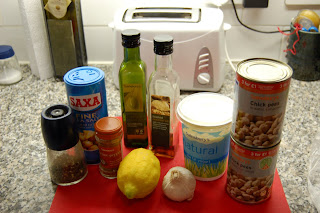 Put the chickpeas, yogurt, garlic, lemon juice and oils into a food processor and whiz everything up for a couple of minutes until it's fairly smooth. Add more yogurt if needed to thin it out.
 Taste, and then add seasonings. Taste a few times while adding the seasoning to be sure you don't get too much. Also, some chickpeas come canned in salted water (rather than unsalted). If there is salt in the chickpeas, be sure to rinse them well, and start out easy on the added salt.
Enjoy with pita bread or, if you're trying to be really healthy, fresh raw veggies (carrots, celery, cherry tomatoes, snap peas, green beans).
For a fancy touch, drizzle some good olive oil over the top of the hummus in the serving bowl and sprinkle with some paprika or cayenne pepper. You can even add a sprig of parsley or a few whole chickpeas to the center of the dish.
Finally, the tips. This hummus is lower-fat because the large quantities of olive oil and tahini traditionally found in hummus is replaced with yogurt and just a small amount of oil (sesame for a tahini-like flavor). In all, there is about 20 g of fat in the whole batch, and since it makes so much, it works out to about 2 g per serving, I think. Lowfat plain yogurt is a great way to reduce the amount of fat in other dishes as well. For example, it can replace sour cream when used as a condiment (like on your tacos or baked potato), not in baking. It can also be used in place of some or all of the mayo in things like tuna salad.
The other tips involve juicing the lemon. Before cutting the lemon (or other citrus fruit) in half for juicing, roll it on the counter under the palm of your hand to get the juices flowing. Also, when you juice the fruit, you can use a fancy gizmo, but you can also just squeeze the lemon in your hand, letting the juice run through your fingers to catch the seeds.
What do I make at home that might seem a bit odd to some people, and why do I bother? Hummus, salsa, pesto, mac and cheese, Chex mix, pizza dough, bread (though I did the latter 2 far more when I lived in the US and had a breadmaker), the list goes on. I've even been making milk at home for the past 4 months (ew, gross, I know). Seriously, though, I once even made my own ketchup, and experimented with flour tortillas but for all the work they weren't really that great. One day I swear I am going to try making my own bagels (my friend A gave me a recipe about 8 years ago...) and doughnuts (I just saw what sounds like a brilliant recipe for baked doughnuts and can't wait to try it...), granola and pasta. I suppose I should make my own mayo (and bacon/pancetta as one of my friends is doing) as well, but who has time for that?
So why? Well, sometimes because I wanted a healthier version of something (eg, lower-fat hummus and pesto), sometimes because I couldn't find a version to my liking in the UK (eg, the salsa), and sometimes just because I wanted to see if I could (and if my version would taste better than store-bought).
And now the fun part. The tip of the day. Well, it's actually a recipe of the day. But, there are a couple of tips buried within it.
Lower-fat homemade hummus
2 small cans of chickpeas (each 410 g/240 g drained), drained and rinsed (not sure of equivalent American can sizes - should be about 14-15 oz)
1/4 c plain lowfat (or fat free) yogurt
2-3 garlic cloves, roughly chopped
juice of 1 lemon
1 T sesame oil
2 tsp olive oil
salt to taste (1/4-1/2 tsp)
freshly ground black pepper (about 1/8 tsp)
pinch of cayenne pepper (to taste; I use about 1/8 tsp)
 Put the chickpeas, yogurt, garlic, lemon juice and oils into a food processor and whiz everything up for a couple of minutes until it's fairly smooth. Add more yogurt if needed to thin it out.
 Taste, and then add seasonings. Taste a few times while adding the seasoning to be sure you don't get too much. Also, some chickpeas come canned in salted water (rather than unsalted). If there is salt in the chickpeas, be sure to rinse them well, and start out easy on the added salt.
Enjoy with pita bread or, if you're trying to be really healthy, fresh raw veggies (carrots, celery, cherry tomatoes, snap peas, green beans).
For a fancy touch, drizzle some good olive oil over the top of the hummus in the serving bowl and sprinkle with some paprika or cayenne pepper. You can even add a sprig of parsley or a few whole chickpeas to the center of the dish.

Finally, the tips. This hummus is lower-fat because the large quantities of olive oil and tahini traditionally found in hummus is replaced with yogurt and just a small amount of oil (sesame for a tahini-like flavor). In all, there is about 20 g of fat in the whole batch, and since it makes so much, it works out to about 2 g per serving, I think. Lowfat plain yogurt is a great way to reduce the amount of fat in other dishes as well. For example, it can replace sour cream when used as a condiment (like on your tacos or baked potato), not in baking. It can also be used in place of some or all of the mayo in things like tuna salad.
The other tips involve juicing the lemon. Before cutting the lemon (or other citrus fruit) in half for juicing, roll it on the counter under the palm of your hand to get the juices flowing. Also, when you juice the fruit, you can use a fancy gizmo, but you can also just squeeze the lemon in your hand, letting the juice run through your fingers to catch the seeds.
Subscribe to:
Posts (Atom)